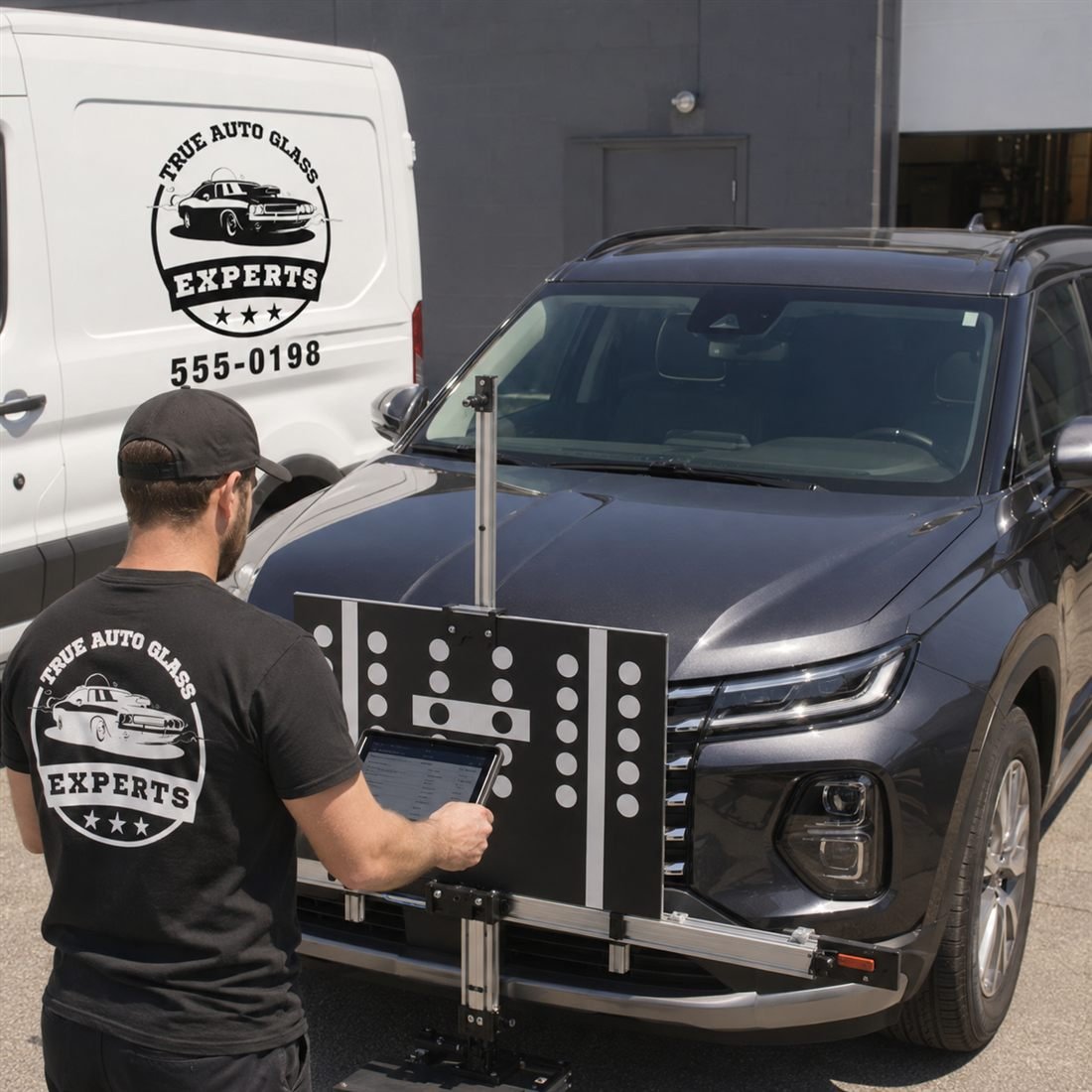
We help drivers restore accurate camera and sensor alignment after windshield replacement, collision repair, or ADAS warning alerts.

ADAS calibration is the process of realigning advanced driver assistance cameras and sensors so safety systems read the road correctly. Many vehicles use a forward-facing camera near the rearview mirror, radar modules, ultrasonic sensors, and vehicle control modules to support braking alerts, lane keeping, distance control, pedestrian detection, and traffic sign recognition.
Windshield replacement commonly requires calibration because the camera bracket, glass angle, optical clarity, and mounting position affect system accuracy. True Auto Glass Experts complete ADAS calibration with vehicle-specific procedures, scan tools, calibration targets, and OEM repair information.
Vehicle owners need ADAS calibration whenever a manufacturer requirement, warning message, diagnostic scan, or repair event calls for camera or sensor alignment.
A vehicle can look ready to drive after glass work while the camera system still needs calibration. Windshield replacement can disturb a camera’s mounting position, viewing angle, or relationship with the vehicle centerline. Collision repair, suspension work, and alignment changes can also affect how safety modules read road position.
Common signs and service triggers include:
True Auto Glass Experts reviews the vehicle, identifies ADAS-related service needs, and recommends the correct calibration path.
Static and dynamic ADAS calibration follow different manufacturer rules, and True Auto Glass Experts selects the required method for the vehicle’s year, make, model, system type, and camera package.
Static ADAS calibration uses a controlled service setting, specialized targets, measurement references, diagnostic equipment, and vehicle-specific setup rules. A static service may apply when the vehicle manufacturer requires target boards, controlled lighting, level positioning, distance references, or precise camera aiming conditions. True Auto Glass Experts handle static calibration as a professional service, not a driver instruction process.
Dynamic ADAS calibration allows certain vehicle systems to learn from road conditions during a controlled service drive. A dynamic service may apply when manufacturer rules call for lane markings, steady speeds, clear visibility, and diagnostic monitoring. True Auto Glass Experts reviews requirements before service and confirms the correct path for the vehicle.
Some vehicles require both static and dynamic calibration. Service method depends on the safety system design, not preference.
ADAS calibration after windshield replacement helps the forward-facing camera read lanes, vehicles, signs, and distance cues from a correct viewing angle.
A new windshield can change the relationship between the camera bracket, glass surface, mounting point, and road view. Even a slight variation can affect how the safety system interprets lane markings or traffic distance. A clean glass installation alone does not complete the safety system service for many modern vehicles.
True Auto Glass Experts pairs auto glass knowledge with ADAS calibration service, which helps drivers complete the repair path after windshield replacement. Service may be recommended after glass replacement on vehicles from many manufacturers, including Toyota, Honda, Ford, Chevrolet, Nissan, Hyundai, Kia, Subaru, Mercedes-Benz, BMW, Audi, Volkswagen, Lexus, Acura, Jeep, Ram, GMC, and Mazda.
True Auto Glass Experts gives drivers a clear ADAS calibration appointment focused on service accuracy, system verification, and simple communication.
A customer-first calibration visit may include:
Vehicle Review
The team checks vehicle details, ADAS features, windshield status, and customer concerns.
Diagnostic Check
The service process can include scan support for ADAS-related codes, warnings, or module communication issues.
Calibration Method Selection
The technician identifies static, dynamic, or combined calibration needs based on vehicle requirements.
Professional Calibration Service
The team performs the required calibration with proper equipment, vehicle data, and service controls.
Verification and Notes
The customer receives a clear service summary and next-step information when additional vehicle attention is needed.
Customers choose True Auto Glass Experts for ADAS calibration because we pair auto glass knowledge with safety system procedures that protect vehicle function after windshield service.
Glass and Camera Expertise
ADAS camera accuracy starts at the windshield. Our team checks camera brackets, glass optical zones, rain sensors, and mirror-mounted assemblies before calibration.
Documented Procedures
We follow OEM repair information and record scan results. Drivers receive clear proof that the system passed calibration or needs further diagnosis.
Modern Calibration Equipment
We use professional scan tools, target systems, battery support, and measuring equipment suited to advanced driver assistance service.
Insurance-Ready Records
Many insurers require proof after windshield replacement on ADAS-equipped vehicles. Our documentation helps support claims, approvals, and repair records.
ADAS calibration typically costs $250 to $450 USD, depending on vehicle brand, sensor type, calibration method, diagnostic time, and documentation requirements. True Auto Glass Experts provides a free estimate before service so drivers know the expected cost before scheduling.
Price factors include static vs. dynamic calibration, camera-only vs. multi-sensor systems, post-repair fault codes, European or luxury vehicle procedures, and insurance documentation needs. Some vehicles require additional scan time or manufacturer-specific calibration steps before the system can pass verification.
You usually need calibration after windshield replacement, camera removal, collision repair, suspension work, wheel alignment, ADAS warning lights, or failed safety system checks.
Professional calibration requires OEM procedures, scan tools, target placement, level conditions, and documented verification. Guesswork can leave safety systems inaccurate.
Most eligible vehicles take 60 to 120 minutes. Some vehicles need more time because road conditions, lighting, fault codes, or multi-sensor systems affect the process.
Skipping calibration can cause lane assist, forward collision warning, and emergency braking systems to misread distance, lane markings, or vehicles ahead.
We service many ADAS platforms, including Toyota Safety Sense, Honda Sensing, Subaru EyeSight, Ford Co-Pilot360, GM Safety Assist, Nissan Safety Shield 360, Hyundai SmartSense, Kia Drive Wise, and more.
Drivers can schedule ADAS calibration with True Auto Glass Experts after windshield replacement, camera disturbance, dashboard warning messages, collision repair, or manufacturer-required recalibration events.